
Euro gives back early gains as US Dollar rebounds, US NFP data awaited
- Euro gives up its early gains as the US Dollar bounces back.
- The US Dollar recovers early losses despite US political headwinds and lower oil prices.
- An expected growth in Eurozone’s flash HICP has strengthened the case of more ECB interest rate hikes.
The Euro (EUR) surrenders almost its entire early gains against the US Dollar (USD) in the European trading session on Thursday. The EUR/USD pair flattens at around 1.1228 after retreating from its day’s high of 1.1268. The major currency pair falls back as the US Dollar recovers its losses, with the US Dollar Index (DXY) bouncing back and turning slightly positive at around 101.54.
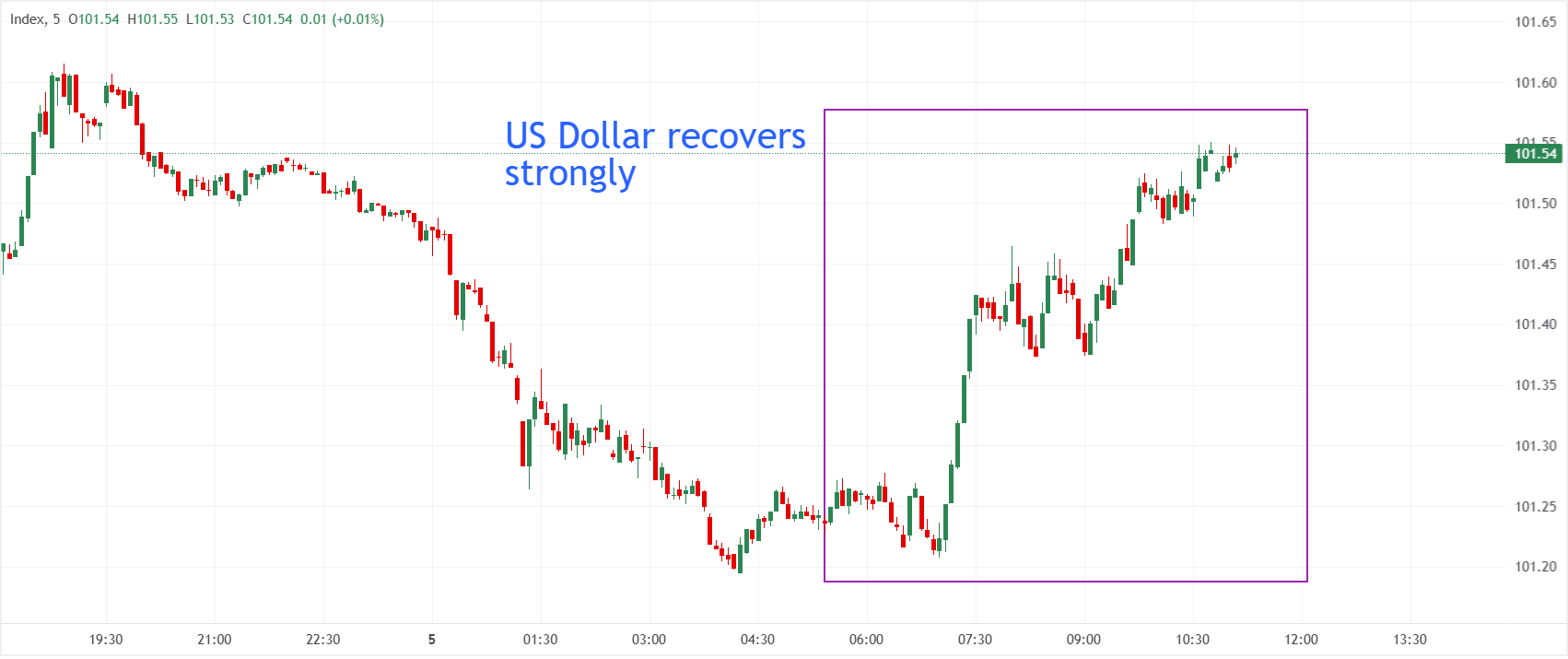
However, market experts doubt the continuation of US Dollar’s recovery amid headwinds from United States (US) political turbulence and a sharp decline in oil prices.
Analysts at MUFG highlight that the “weaker US dollar and lower US yields have been encouraged by the sharp decline in the price of oil which is helping to ease market concerns over upside inflation risks.” They point out that the price of Brent “has fallen by around USD10/barrel since the US mid-term elections results were announced,” dropping back towards support from the “200-day moving average at around USD93.60/barrel.” MUFG notes that oil “had already been falling sharply at the start of this week and the mid-term election results have reinforced the sell-off.”
The bank also flags “another downside risk for the US dollar from the US mid-term election,” namely the potential for the outcome “to further undermine investor confidence in US AI-related investments in response to increased Democratic opposition to the ongoing AI build-out.”
On the economic front, investors await the US Nonfarm Payrolls (NFP) data for October, which will be released on Friday. The US NFP data will likely influence Federal Reserve’s (Fed) interest rate expectations.
For now, traders are confident that the Fed will hike interest rates by 25 basis points (bps) to the 4.00%-4.25% range in the December policy meeting.
On the Euro front, further acceleration in Eurozone inflationary pressures has strengthened expectations of more interest rate hikes by the European Central Bank (ECB) in the near term.
Euro underpinned as ECB faces renewed pressure from stubborn inflation
Commerzbank’s Antje Praefcke highlights that the latest Eurozone data keep the policy debate tilted toward further tightening, noting that “at the same time, euro area inflation rose to 4% year-on-year in October, while the core rate remained unchanged at 2.5%.” She points out that “although these figures were in line with analysts’ expectations, with an inflation target of 2% and a deposit rate of 2.50%, they clearly make the case for further ECB rate hikes.” In her view, “as a consequence of persistently high energy prices, an increasing number of companies is likely to pass on higher costs over time,” reinforcing the argument for additional ECB action and helping to underpin the Euro despite lingering growth concerns.
EUR/USD Technical Analysis
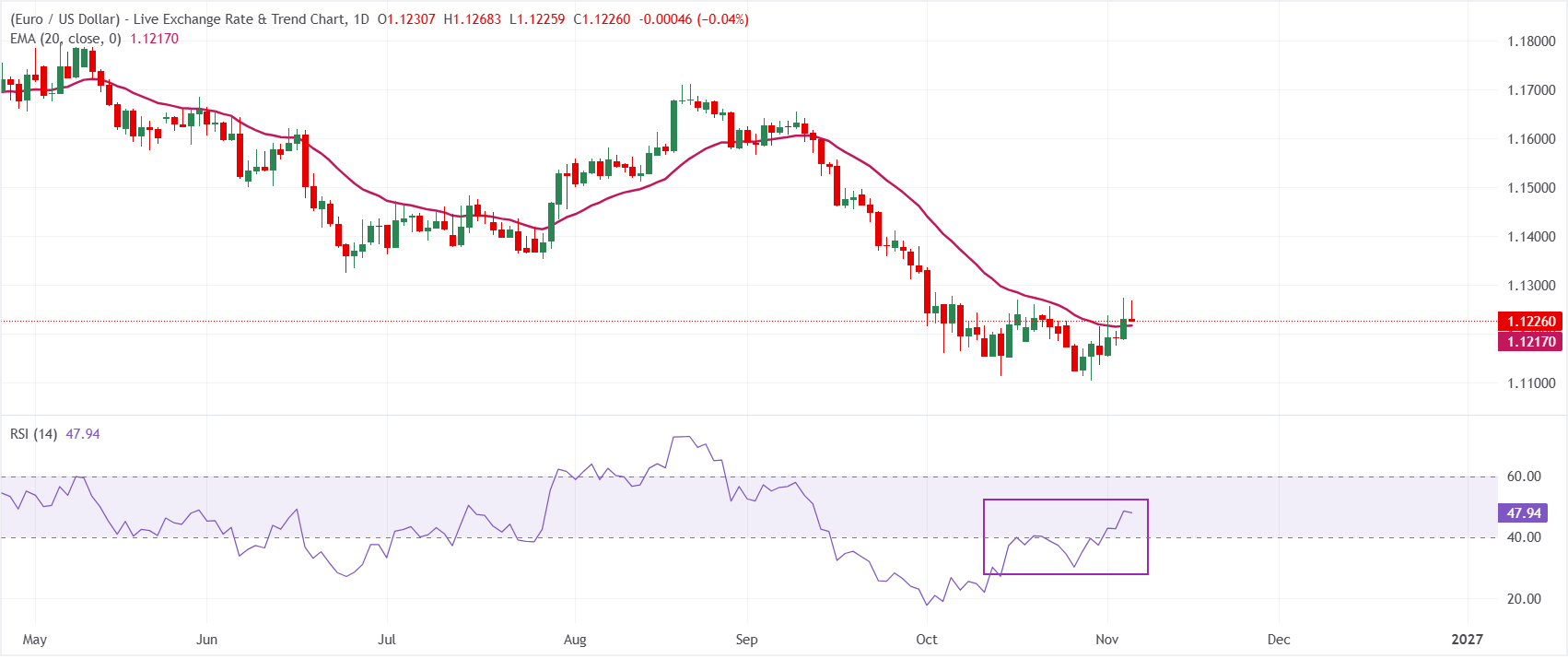
In the daily chart, EUR/USD trades at 1.1228. The pair holds just above the 20-day exponential moving average (EMA) at 1.1217, hinting at a tentative stabilization after the recent decline, though the absence of nearby overhead reference levels keeps the broader tone neutral rather than decisively bullish. The Relative Strength Index (RSI) at 48 is recovering toward the midline, suggesting fading downside momentum but not yet a clear upside acceleration.
On the downside, initial support is located at the 20-day EMA at 1.1217, where a sustained break would reopen the risk of a deeper pullback toward prior lows on the chart. As long as spot continues to defend this moving average and RSI holds near the 50 region, the pair could remain in a consolidation phase, with buyers attempting to build a base while awaiting a clearer topside reference to challenge.
(The technical analysis of this story was written with the help of an AI tool. Know more.)
Economic Indicator
Harmonized Index of Consumer Prices (YoY)
The Harmonized Index of Consumer Prices (HICP) measures changes in the prices of a representative basket of goods and services in the European Monetary Union. The HICP, released by Eurostat on a monthly basis, is harmonized because the same methodology is used across all member states and their contribution is weighted. The YoY reading compares prices in the reference month to a year earlier. Generally, a high reading is seen as bullish for the Euro (EUR), while a low reading is seen as bearish.
Read more.Last release: Wed Nov 04, 2026 10:00 (Prel)
Frequency: Monthly
Actual: 4%
Consensus: 4%
Previous: 3.8%
Source: Eurostat