
EUR/USD Price Forecast: At make or a break near 1.1350
- EUR/USD edges down to near 1.1375 as the US Dollar remains broadly firm.
- Fed officials have warned of upside inflation risks and have signalled optimism on economic outlook.
- The Euro is expected to raise policy rates again this year.
The Euro (EUR) trades marginally lower at around 1.1375 against the US Dollar (USD) in the early European trade on Friday, but is inside Thursday’s trading range. The major currency pair is broadly under pressure as the US Dollar (USD) outperforms across the board.
At press time, the US Dollar Index (DXY), which tracks the Greenback’s value against six major currencies, trades close to its eight-week high of 101.40 posted on Thursday.
Market experts see more strength in the US Dollar as Federal Reserve (Fed) officials have guided a hawkish monetary policy path and signaled economic resilience.
Dollar strength underpinned as Fed officials flag scope for further tightening
Strategists at Brown Brothers Harriman observe that the USD is “powering forward against most major currencies,” with a hawkish Fed stance and widening US economic growth outperformance suggesting the Dollar “can keep flexing its muscle.” They point to comments from Fed Governor Michael Barr, who warned that “further policy adjustments are likely to be needed to ensure inflation comes down to target in a timely fashion,” reinforcing expectations that policy may need to tighten further.
BBH also highlights remarks from New York Fed President John Williams, who said the US economy shows “remarkable resilience,” while inflation remains the “big challenge” and that “another rate hike may be appropriate by the end of the year.” Taken together, BBH argues that Barr and Williams’ comments “strengthen the case for additional Fed funds rate hikes,” providing a supportive backdrop for continued Dollar strength.
Though investors have underpinned the US Dollar over the Euro, the latter has performed majorly positive against its other peers amid expectations that the European Central Bank (ECB) will hike policy rates again this year.
EUR/USD Technical Analysis
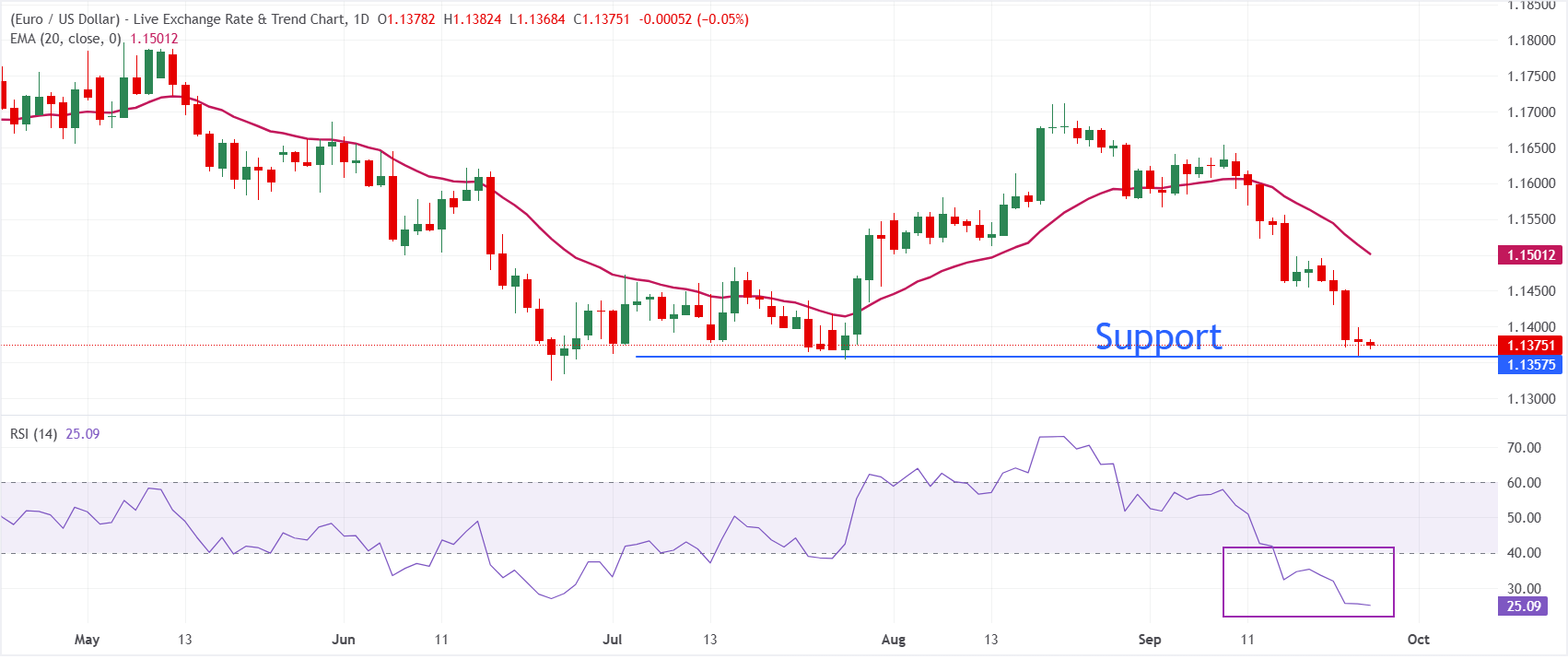
In the daily chart, EUR/USD trades at 1.1376, maintaining a bearish near-term bias as spot holds below the 20-period exponential moving average (EMA) at 1.1501. The pair has retreated steadily from recent highs, and while the Relative Strength Index (14) sits deep in oversold territory near 25, this momentum reading only hints at stretched downside conditions rather than a confirmed reversal signal.
On the topside, initial resistance is located at the 20-period EMA around 1.1501, which acts as the first barrier that bulls would need to reclaim to ease immediate selling pressure; before that, the 1.1400 level is the critial hurdle.
On the downside, the pair coudl enter a fresh downside leg if it fails to hold the immediate cushion at around 1.1350.
(The technical analysis of this story was written with the help of an AI tool. Know more.)
Fed FAQs
Monetary policy in the US is shaped by the Federal Reserve (Fed). The Fed has two mandates: to achieve price stability and foster full employment. Its primary tool to achieve these goals is by adjusting interest rates. When prices are rising too quickly and inflation is above the Fed’s 2% target, it raises interest rates, increasing borrowing costs throughout the economy. This results in a stronger US Dollar (USD) as it makes the US a more attractive place for international investors to park their money. When inflation falls below 2% or the Unemployment Rate is too high, the Fed may lower interest rates to encourage borrowing, which weighs on the Greenback.
The Federal Reserve (Fed) holds eight policy meetings a year, where the Federal Open Market Committee (FOMC) assesses economic conditions and makes monetary policy decisions. The FOMC is attended by twelve Fed officials – the seven members of the Board of Governors, the president of the Federal Reserve Bank of New York, and four of the remaining eleven regional Reserve Bank presidents, who serve one-year terms on a rotating basis.
In extreme situations, the Federal Reserve may resort to a policy named Quantitative Easing (QE). QE is the process by which the Fed substantially increases the flow of credit in a stuck financial system. It is a non-standard policy measure used during crises or when inflation is extremely low. It was the Fed’s weapon of choice during the Great Financial Crisis in 2008. It involves the Fed printing more Dollars and using them to buy high grade bonds from financial institutions. QE usually weakens the US Dollar.
Quantitative tightening (QT) is the reverse process of QE, whereby the Federal Reserve stops buying bonds from financial institutions and does not reinvest the principal from the bonds it holds maturing, to purchase new bonds. It is usually positive for the value of the US Dollar.