
Silver Price Forecast: XAG/USD corrects $66.30 amid caution ahead of US NFP data
- Silver price retreats from $68 while the US NFP data takes centre stage.
- Traders have trimmed Fed interest rate hike expectations following Fed Waller’s remarks.
- Fed’s Waller said that recent data shows signs of disinflation.
Silver price (XAG/USD) retreats to near $66.30 in the European trading session on Friday after posting a fresh five-day high near $68.00. The white metal comes under pressure ahead of the United States (US) Nonfarm Payrolls (NFP) data for August, which will be published at 12:30 GMT.
According to TD Securities, the US labour market is set for a partial recovery in August, with the bank forecasting that "August NFP [will] rebound to 95k after July posted a decline of 23k." The firm also expects limited movement in joblessness, noting that "the UE rate likely went sideways at 4.1% with balanced risks."
Investors will closely track the US NFP data to get fresh cues regarding the Federal Reserve’s (Fed) monetary policy outlook. In TD’s view, a modestly hawkish employment report will reaffirm the Fed's attention on inflation, but it will be by itself unlikely to push the Committee towards hikes, suggesting that even a stronger print would not materially alter the current policy stance.
Meanwhile, traders have diminished Fed interest rate expectations after comments from Governor Christopher Waller on Thursday, in which he said that recent data shows signs of disinflation.
Analysts at Commerzbank also said that lingering uncertainty over the US rate outlook was “underscored yesterday by comments from Fed Governor Christopher Waller,” who, in their words, signalled that “a rate hike is by no means necessary.” They add that Waller “also confirmed what we have been arguing: next week’s inflation data are likely to be the key input for the Fed’s upcoming policy decision,” a shift in emphasis that, in their view, “further [reduces] the significance of today’s employment report.”
Silver Technical Analysis
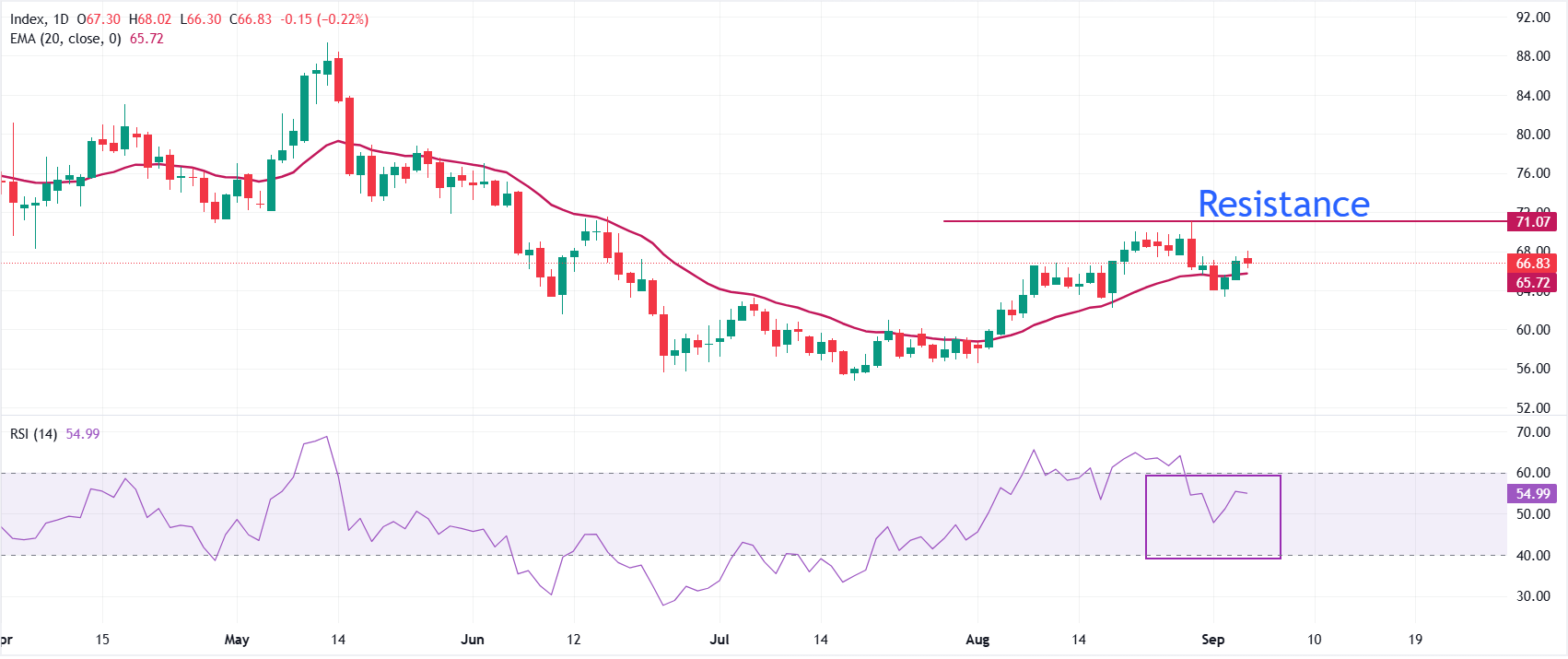
In the daily chart, XAG/USD trades at $66.73, maintaining a bullish near-term bias as it holds above the 20-day exponential moving average (EMA) at roughly $65.71. The metal is advancing within an uptrend structure, with price comfortably supported by this short-term EMA, while the Relative Strength Index (RSI) around 55 suggests moderate bullish momentum without yet signaling overbought conditions.
On the downside, immediate support is seen at the 20-day EMA near $65.71, where a break would expose the white metal to a deeper correction. Looking up, the August high at $71.12 is the key hurdle.
(The technical analysis of this story was written with the help of an AI tool. Know more.)
Silver FAQs
Silver is a precious metal highly traded among investors. It has been historically used as a store of value and a medium of exchange. Although less popular than Gold, traders may turn to Silver to diversify their investment portfolio, for its intrinsic value or as a potential hedge during high-inflation periods. Investors can buy physical Silver, in coins or in bars, or trade it through vehicles such as Exchange Traded Funds, which track its price on international markets.
Silver prices can move due to a wide range of factors. Geopolitical instability or fears of a deep recession can make Silver price escalate due to its safe-haven status, although to a lesser extent than Gold's. As a yieldless asset, Silver tends to rise with lower interest rates. Its moves also depend on how the US Dollar (USD) behaves as the asset is priced in dollars (XAG/USD). A strong Dollar tends to keep the price of Silver at bay, whereas a weaker Dollar is likely to propel prices up. Other factors such as investment demand, mining supply – Silver is much more abundant than Gold – and recycling rates can also affect prices.
Silver is widely used in industry, particularly in sectors such as electronics or solar energy, as it has one of the highest electric conductivity of all metals – more than Copper and Gold. A surge in demand can increase prices, while a decline tends to lower them. Dynamics in the US, Chinese and Indian economies can also contribute to price swings: for the US and particularly China, their big industrial sectors use Silver in various processes; in India, consumers’ demand for the precious metal for jewellery also plays a key role in setting prices.
Silver prices tend to follow Gold's moves. When Gold prices rise, Silver typically follows suit, as their status as safe-haven assets is similar. The Gold/Silver ratio, which shows the number of ounces of Silver needed to equal the value of one ounce of Gold, may help to determine the relative valuation between both metals. Some investors may consider a high ratio as an indicator that Silver is undervalued, or Gold is overvalued. On the contrary, a low ratio might suggest that Gold is undervalued relative to Silver.