
Gold Price Forecast: XAU/USD tests $4,300 amid Fed tightening hopes, geopolitical tensions
- XAU/USD hits fresh two-week lows below $4,300 and is 3.25% down on the week so far.
- The US Dollar extends its recovery, buoyed by Fed hiking bets and growing geopolitical tensions.
- Momentum indicators show Gold coming under growing bearish pressure.
Gold (XAU/USD) maintains its bearish trend on Wednesday, as higher geopolitical tensions and growing bets of a Federal Reserve (Fed) rate hike in September boost speculative support to the US Dollar. The precious metal is testing the support area around $4,300 as of writing, 3.25% down on the week so far.
Bullion has been struggling since the US Fed Chairman Kevin Warsh boosted expectations of an interest rate hike in September at the Jackson Hole central banker’s summit on Friday. Warsh struck an unexpectedly hawkish tone, affirming that prices should be the central bank’s main concern right now and that they have “work to do” to bring interest rates to the 2% target.
Beyond that, the resumption of hostilities between the US and Iran has increased risk aversion, providing additional support for the safe-haven USD. The US military launched a new wave of strikes on Islamic Revolutionary Guard Corps (IRGC) positions across Iran, which were responded to with attacks on US bases in Bahrain, Iraq and Jordan.
Technical Analysis: Gold comes under growing bearish pressure
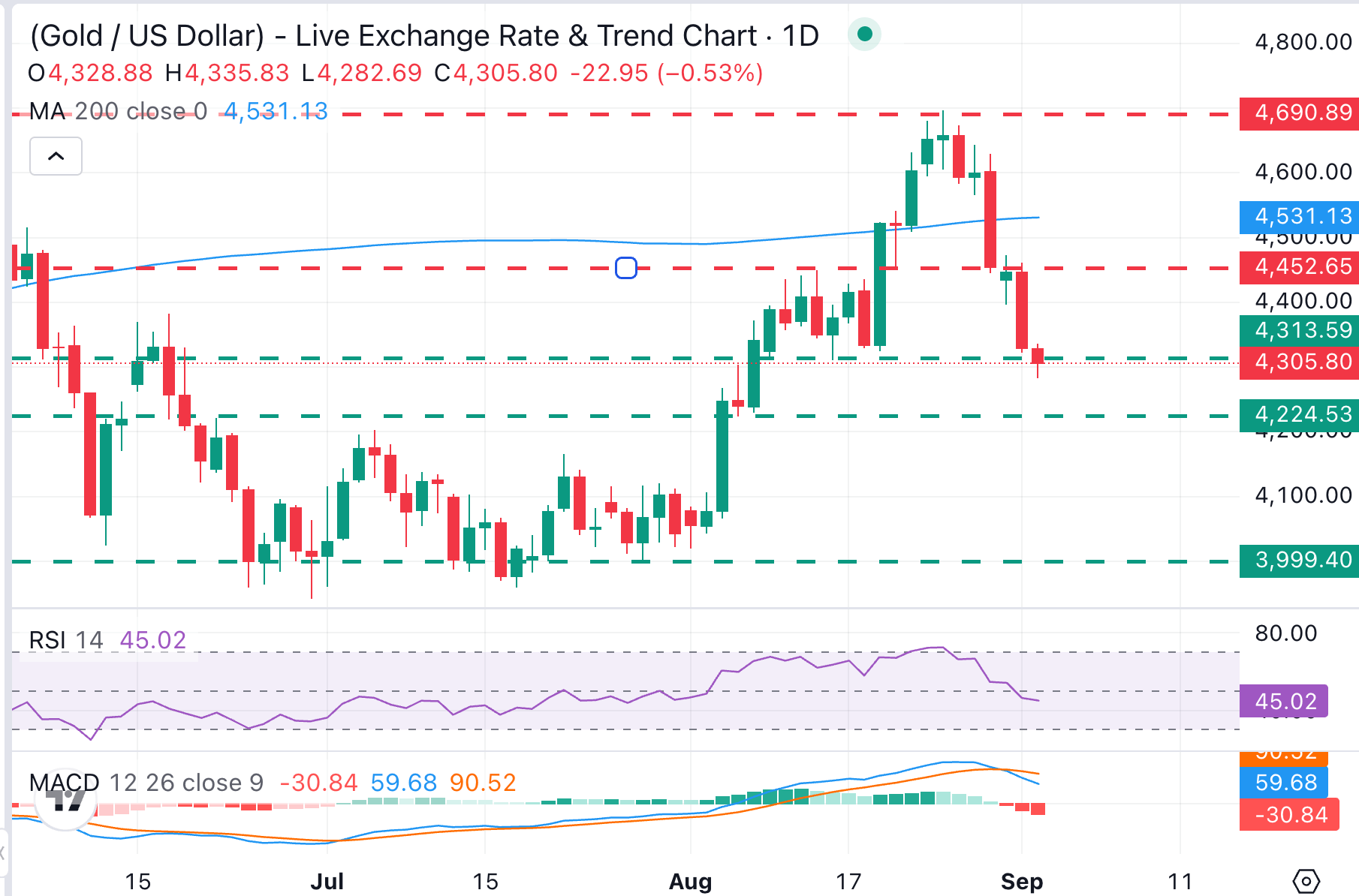
XAU/USD trades at $4,310, holding an immediate bearish tone below the 200-day simple moving average (SMA), with momentum indicators showing growing negative traction. The daily Relative Strength Index (RSI) has broken below the key 50 line, while the Moving Average Convergence Divergence (MACD) is deeply negative at -30.53, altogether hinting at solid downside momentum.
A clear break below the mentioned $4,300 area (August 14, 18 and 19 lows) would clear the path toward the August 6 low, near $ 4,225, ahead of the late July lows in the $4,000 area
On the topside, the previous support area around $4,450 (August 20 low) is likely to act as resistance now. Further up, the mentioned 200-day SMA, at the $4,530 area, will challenge bulls ahead of last week's highs, near $4,700.
(The technical analysis of this story was written with the help of an AI tool. Know more.)
Gold FAQs
Gold has played a key role in human’s history as it has been widely used as a store of value and medium of exchange. Currently, apart from its shine and usage for jewelry, the precious metal is widely seen as a safe-haven asset, meaning that it is considered a good investment during turbulent times. Gold is also widely seen as a hedge against inflation and against depreciating currencies as it doesn’t rely on any specific issuer or government.
Central banks are the biggest Gold holders. In their aim to support their currencies in turbulent times, central banks tend to diversify their reserves and buy Gold to improve the perceived strength of the economy and the currency. High Gold reserves can be a source of trust for a country’s solvency. Central banks added 1,136 tonnes of Gold worth around $70 billion to their reserves in 2022, according to data from the World Gold Council. This is the highest yearly purchase since records began. Central banks from emerging economies such as China, India and Turkey are quickly increasing their Gold reserves.
Gold has an inverse correlation with the US Dollar and US Treasuries, which are both major reserve and safe-haven assets. When the Dollar depreciates, Gold tends to rise, enabling investors and central banks to diversify their assets in turbulent times. Gold is also inversely correlated with risk assets. A rally in the stock market tends to weaken Gold price, while sell-offs in riskier markets tend to favor the precious metal.
The price can move due to a wide range of factors. Geopolitical instability or fears of a deep recession can quickly make Gold price escalate due to its safe-haven status. As a yield-less asset, Gold tends to rise with lower interest rates, while higher cost of money usually weighs down on the yellow metal. Still, most moves depend on how the US Dollar (USD) behaves as the asset is priced in dollars (XAU/USD). A strong Dollar tends to keep the price of Gold controlled, whereas a weaker Dollar is likely to push Gold prices up.