
GBP/USD Price Forecast: Gathers strength for VCP breakout
- GBP/USD edges down to near 1.3460 while investors shift their focus to the US NFP data.
- The US official employment data will have a significant impact on the Fed’s monetary policy outlook.
- The Cable appears to be gathering strength for a decisive breakout of the VCP pattern.
The British Pound (GBP) trades marginally lower at around 1.3460 against the US Dollar (USD) during the European trading session on Thursday. The GBP/USD pair is expected to trade sideways as investors await the United States (US) Nonfarm Payrolls (NFP) data for July, which will be released on Friday.
US payrolls seen posting modest July gain as Deutsche Bank flags participation risks
Economists at Deutsche Bank expect Friday’s July payrolls report to show a further, if modest, improvement in hiring. They look for "employment growth of +65k, modestly above June’s +57k reading".
On the labor market’s slack, Deutsche Bank forecasts that "the unemployment rate is forecast to remain at 4.2%, although risks are skewed towards a rounding up to 4.3% if labor force participation rebounds after last month’s sharp decline." Wage and hours data are expected to be steady, with "average hourly earnings… expected to increase by +0.3% month-on-month, unchanged from June, while average hours worked are forecast to hold at 34.3 hours."
Investors will pay close attention to the US NFP data as it will influence market expectations for the Federal Reserve’s (Fed) monetary policy outlook.
Ahead of the US NFP data for July, the ADP Employment Change data remained weaker-than-projected. On Wednesday, the ADP reported that the private sector created 44K jobs in July, fewer than estimates of 70K and the prior release of 98K.
Technical Analysis
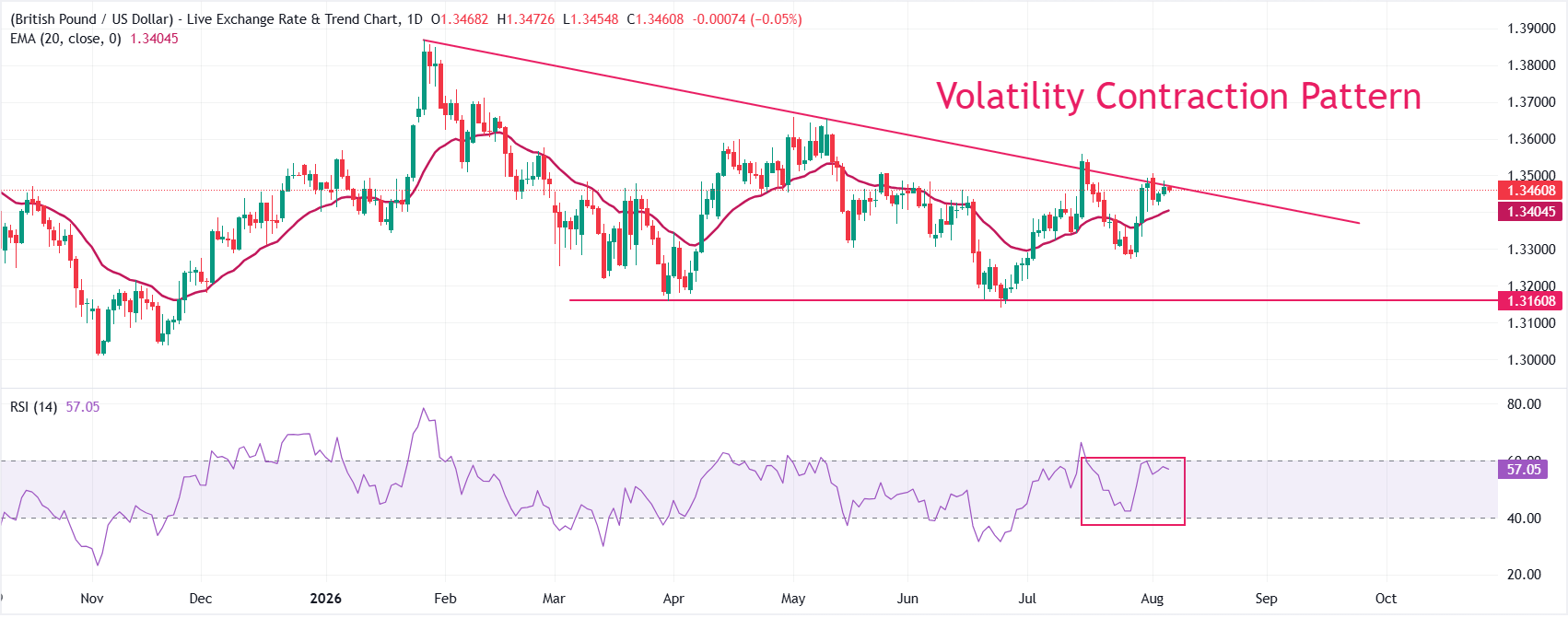
GBP/USD trades at around 1.3460, keeping a mildly bullish near-term bias as spot holds above the 20-day exponential moving average (EMA) at 1.3404, but struggles to achieve a decisive breakout of the downward-sloping border of the Volatility Contraction Pattern (VCP) at around 1.3471.
The Relative Strength Index (RSI) around 57 shows constructive but not overextended momentum, suggesting scope for further gains as long as price stays supported on dips above the EMA.
On the topside, immediate resistance is located at the former trend line break price at 1.3471, and a decisive move above this barrier would open the way for a continuation of the recent upside. Looking up, the July 15 high at 1.3558 is the key hurdle. On the downside, initial support is seen at the 20-day EMA at 1.3404, followed by the July 28 low at 1.3274.
(The technical analysis of this story was written with the help of an AI tool. Know more.)
Nonfarm Payrolls FAQs
Nonfarm Payrolls (NFP) are part of the US Bureau of Labor Statistics monthly jobs report. The Nonfarm Payrolls component specifically measures the change in the number of people employed in the US during the previous month, excluding the farming industry.
The Nonfarm Payrolls figure can influence the decisions of the Federal Reserve by providing a measure of how successfully the Fed is meeting its mandate of fostering full employment and 2% inflation. A relatively high NFP figure means more people are in employment, earning more money and therefore probably spending more. A relatively low Nonfarm Payrolls’ result, on the either hand, could mean people are struggling to find work. The Fed will typically raise interest rates to combat high inflation triggered by low unemployment, and lower them to stimulate a stagnant labor market.
Nonfarm Payrolls generally have a positive correlation with the US Dollar. This means when payrolls’ figures come out higher-than-expected the USD tends to rally and vice versa when they are lower. NFPs influence the US Dollar by virtue of their impact on inflation, monetary policy expectations and interest rates. A higher NFP usually means the Federal Reserve will be more tight in its monetary policy, supporting the USD.
Nonfarm Payrolls are generally negatively-correlated with the price of Gold. This means a higher-than-expected payrolls’ figure will have a depressing effect on the Gold price and vice versa. Higher NFP generally has a positive effect on the value of the USD, and like most major commodities Gold is priced in US Dollars. If the USD gains in value, therefore, it requires less Dollars to buy an ounce of Gold. Also, higher interest rates (typically helped higher NFPs) also lessen the attractiveness of Gold as an investment compared to staying in cash, where the money will at least earn interest.
Nonfarm Payrolls is only one component within a bigger jobs report and it can be overshadowed by the other components. At times, when NFP come out higher-than-forecast, but the Average Weekly Earnings is lower than expected, the market has ignored the potentially inflationary effect of the headline result and interpreted the fall in earnings as deflationary. The Participation Rate and the Average Weekly Hours components can also influence the market reaction, but only in seldom events like the “Great Resignation” or the Global Financial Crisis.