
Indian Rupee trades flat, lower oil prices back upside
- The Indian Rupee trades flat in the opening session against the US Dollar.
- Iran and Oman are close to finalizing a proposed agreement to control navigation through Hormuz.
- Investors await the US NFP data for July, which will be released on Friday.
The Indian Rupee (INR) opens almost flat against the US Dollar (USD) on Thursday. The USD/INR pair trades around 95.12 after rebounding from the fresh monthly low of 94.83 posted the previous day.
The Indian currency is expected to continue its outperformance as oil prices remain lower due to firm expectations that navigation through the Strait of Hormuz, a critical chokepoint for almost one-fifth of global energy supply, will normalize as Iran and Oman are close to finalizing a framework to manage the chokepoint.
In the opening session, the MCX Crude Oil contract expiring on August 19 trades slightly higher to near Rs. 7,125, but is close to its three-week low of Rs. 7,078 posted on Wednesday.
Iran and Oman close to finalize Hormuz framework
Late Wednesday, Iran’s Foreign Ministry spokesperson, Esmaeil Baghaei, said that Iran and Oman are close to finalizing a proposed framework to manage navigation through the Strait of Hormuz. A senior Gulf official said there is a 50% chance that Iran and Oman will reach an agreement on the Strait of Hormuz by Friday.
Iran’s Baghaei has made it clear that the passage reopening depends on Washington fulfilling its commitment to end the naval blockade on Iranian sea ports.
Meanwhile, continuous attacks from Yemen’s Houthis group on Saudi Arabian tankers attempting to pass the Red Sea route are expected to keep energy supply concerns on the horizon.
Houthi military spokesperson, Yahya Sarea, said in a post on X that Yemen’s forces were able to target the Saudi oil tanker "Daisy" in the Gulf of Aden, adding that the targeting comes within the framework of imposing a maritime navigation ban on the Saudi enemy in accordance with the equation of "siege for siege."
RBI leaves policy rates steady
On Wednesday, the Reserve Bank of India (RBI) left its key Repo Rate unchanged at 5.25%, as expected, for the fourth time in a row. The RBI lowered its inflation forecast for the current year to 5%, but warned that core price pressures could accelerate to 5.9% in the third quarter, citing supply-side pressures from food and fuel.
Meanwhile, investors seek fresh cues regarding how long the RBI’s status quo will continue.
India MPC holds steady for longer as Standard Chartered sees high bar for rate hikes
Economists at Standard Chartered note that India’s Monetary Policy Committee (MPC) “kept the repo rate unchanged at 5.25% in a unanimous decision and maintained its neutral stance, broadly in line with our and consensus expectations.” However, they add that “we were surprised by the relatively dovish tone of the MPC’s statement compared with the April and June policy meetings.”
According to the bank, “while the MPC remains vigilant on future risks, particularly El Niño and crude oil prices, it is inclined to wait for greater clarity on the inflation trajectory and composition before considering rate action.” In their view, “for now, the bar for rate hikes appears high unless inflation materially exceeds expectations,” a conclusion they describe as “consistent with our baseline view of no change in the repo rate in FY27.”
US NFP in spotlight
This week, the major trigger for global markets will be the US Nonfarm Payrolls (NFP) data for July, which will be released on Friday.
According to TD Securities, July payrolls are expected to show only a mild improvement, with the bank looking for "July NFP picked up modestly to 70k after surprising to the downside with 57k in June." The economists judge that "risks to our payrolls forecast appear balanced," suggesting no strong bias toward either a significant upside or downside surprise. On the unemployment side, TD Securities anticipates that "the UE rate likely went sideways at 4.2% after declining in June," pointing to a broadly steady labor market backdrop.
Technical Analysis: USD/INR sees more downside below 94.80
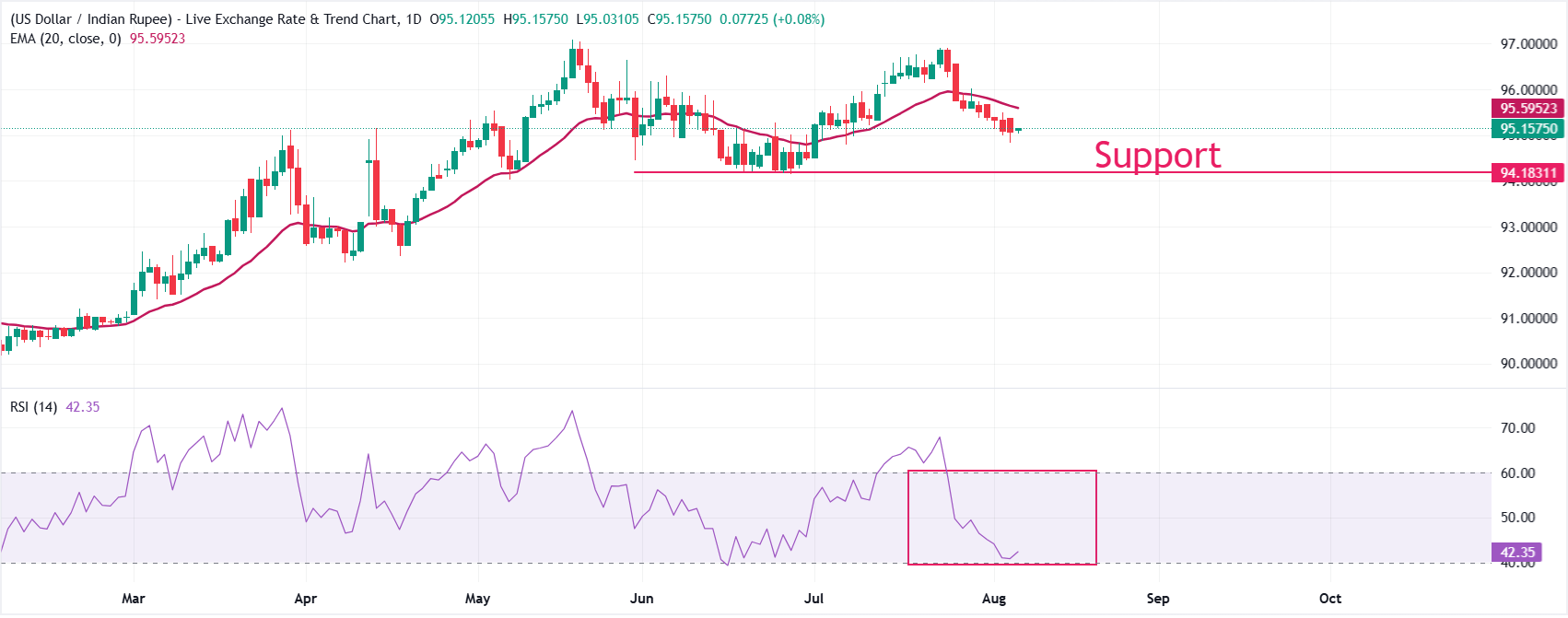
USD/INR trades at around 95.16, keeping a bearish near-term tone as it remains below the 20-day exponential moving average (EMA) at 95.60. The pair has retreated from recent highs, and price holding under this short-term EMA suggests upside attempts are being capped despite the Relative Strength Index (RSI) hovering in a broadly neutral zone around 42, hinting at modest but not extreme selling pressure.
On the topside, immediate resistance is located at the 20-day EMA at 95.60, which is the key barrier that bulls would need to reclaim to ease the current downside bias and open the way for further recovery toward 96.00. Looking down, key support levels are the August 5 low at 94.83 and the June low at 94.15.
(The technical analysis of this story was written with the help of an AI tool. Know more.)
Indian Rupee FAQs
The Indian Rupee (INR) is one of the most sensitive currencies to external factors. The price of Crude Oil (the country is highly dependent on imported Oil), the value of the US Dollar – most trade is conducted in USD – and the level of foreign investment, are all influential. Direct intervention by the Reserve Bank of India (RBI) in FX markets to keep the exchange rate stable, as well as the level of interest rates set by the RBI, are further major influencing factors on the Rupee.
The Reserve Bank of India (RBI) actively intervenes in forex markets to maintain a stable exchange rate, to help facilitate trade. In addition, the RBI tries to maintain the inflation rate at its 4% target by adjusting interest rates. Higher interest rates usually strengthen the Rupee. This is due to the role of the ‘carry trade’ in which investors borrow in countries with lower interest rates so as to place their money in countries’ offering relatively higher interest rates and profit from the difference.
Macroeconomic factors that influence the value of the Rupee include inflation, interest rates, the economic growth rate (GDP), the balance of trade, and inflows from foreign investment. A higher growth rate can lead to more overseas investment, pushing up demand for the Rupee. A less negative balance of trade will eventually lead to a stronger Rupee. Higher interest rates, especially real rates (interest rates less inflation) are also positive for the Rupee. A risk-on environment can lead to greater inflows of Foreign Direct and Indirect Investment (FDI and FII), which also benefit the Rupee.
Higher inflation, particularly, if it is comparatively higher than India’s peers, is generally negative for the currency as it reflects devaluation through oversupply. Inflation also increases the cost of exports, leading to more Rupees being sold to purchase foreign imports, which is Rupee-negative. At the same time, higher inflation usually leads to the Reserve Bank of India (RBI) raising interest rates and this can be positive for the Rupee, due to increased demand from international investors. The opposite effect is true of lower inflation.